

The Paperwork Doesn’t Know Who You Are
What to look for in a severance agreement or performance plan before you sign it, and what you can still ask for.
By Aidan L. Takhteyev
The call usually comes about a week late.
Someone has been handed a packet, sat with it over a weekend, felt the pressure of a date printed on page one, and signed. That’s when the questions start. Something about a vesting date, a clause they skimmed, a number that doesn’t quite reconcile. By the time any of it gets asked out loud, the window that would have let us do something about it has closed.
Reading these documents closely is most of what I do now, and after 15 years in HR, I know where the problems tend to sit. Nobody reads 30 pages of legal drafting well in the worst week of their working life, on a clock someone else set, seeing it for the first time. The people who made this decision have been debating it for weeks. You get a few days to understand their document while you process your own exit. That asymmetry is the point of this article.
Over the past year I’ve read separation agreements, performance improvement plans (PIPs), written warnings and restrictive covenants from employers in very different industries, and the same failures kept turning up in files that had nothing to do with each other. Once that happens often enough, you stop calling it bad luck and start looking at it closely.
If you’re holding a packet with a deadline on it, start with the six steps below. If you can see one coming, read the section on performance plans first.
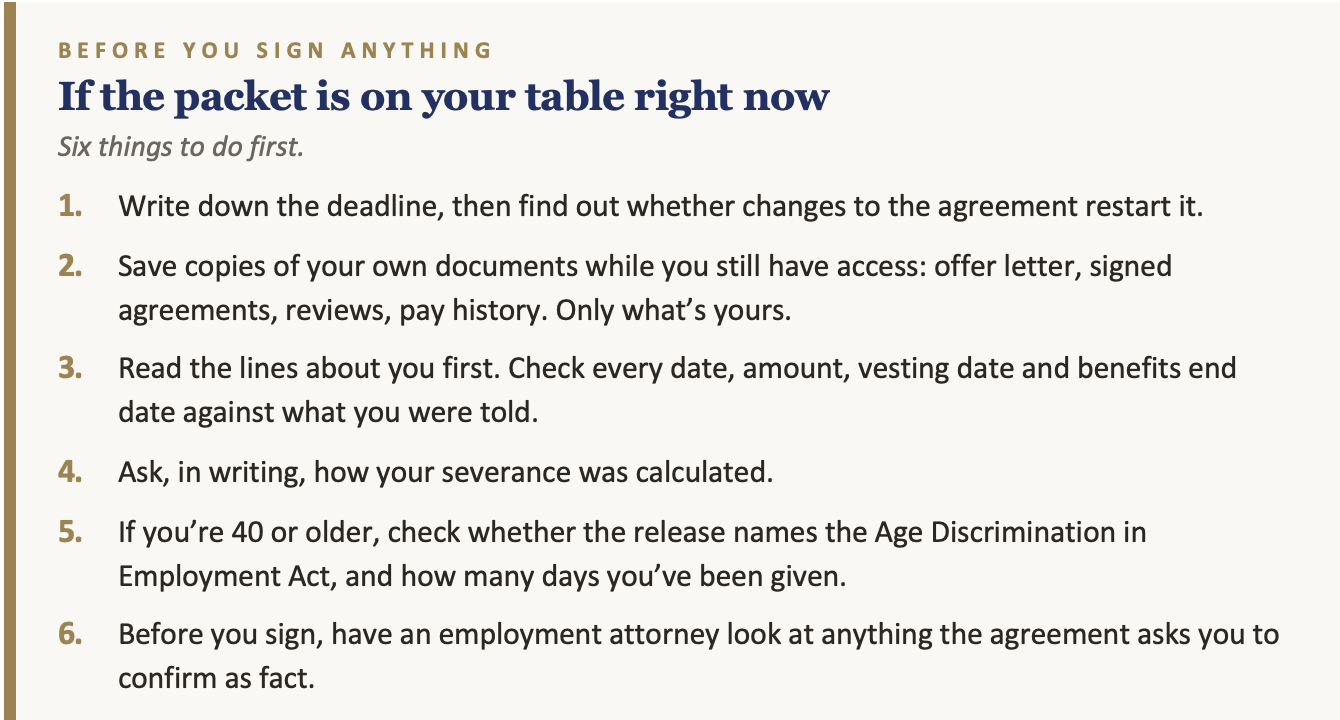
Six things to do before you sign your severance agreement or a PIP
The boilerplate is careful. The part about you is not.
Most people expect the problems to be in the legal language. That’s rarely where they are.
The standard sections of the agreement in front of you are probably very good. The release language is comprehensive, the carve-outs are drawn correctly, and the state-specific addenda handle things most people have never heard of. Somebody competent spent real time on that template, and it shows.
The quality drops off a cliff at the paragraph with your name and your numbers in it.
In the last year alone I’ve seen a company’s internal review checklist left sitting mid-sentence in an agreement someone was being asked to sign. Placeholder fields left blank in the exhibits. A payout promised in a benefits summary that arrived in the same envelope, on the same day, and appears nowhere in the agreement itself. A performance plan with two different end dates in two different sections, never reconciled, after three drafts by several people.
A severance agreement is a template, a corporate asset that gets lawyered. The block with your specifics is assembled by hand, at speed, by someone working through a queue, and that assembly is where errors live. So spend almost none of your attention on the 30 statutes in the release and almost all of it on the six lines that are about you.
Nobody in the room decided this
I’ve sat on the other side of these meetings myself, as an HR professional, so I can tell you what that side of the table is working with.
The person delivering the news probably didn’t make the decision, didn’t write the document, and can’t change a word of it. They’re often skilled, sometimes senior, and now and then they mean it when they say they’re sorry. They were handed someone else’s decision in the form of a script, and their job is to get through 20 minutes without leaving it. The training and the messaging from above point at the same outcome: limit pushback, avoid conflict, work through the list, get signatures. Nobody says it in those words, but that’s what the script is built to do.
The side effect is that the reasoning sounds tighter than it is. Rehearsed language sounds more settled than the thinking behind it, so when you press on it, there’s often nothing underneath. In one matter I worked on, an employer told an employee across months of correspondence that he was a low performer and never once identified a single instance. We asked in writing, more than once. Nothing was produced.
That silence usually lands as validation. There was never anything there, and now everyone can see it. I read it as leverage, with one caveat. Most U.S. employment is at will, which means an employer generally doesn’t need a documented reason to let you go, as long as the real reason isn’t an unlawful one. An unsupported reason weakens everything that comes after, including the terms of your exit, what goes in your file, and any argument that the stated reason was pretext, a cover for something else. A position that can’t be evidenced tends to give ground the first time someone asks, in writing, to see the evidence, and you can be the one who asks.
These documents also tend to name nobody. A ticket queue instead of a contact. A generic reference to “your HR business partner,” with no name attached, in a PIP that sets out a person’s path to keeping their job. If yours names no one, ask in writing who owns the decision and where your questions should go. Once you ask, somebody has to answer for it.
Ask whatever you need to in the room. Save the argument for writing. The room has no authority. What travels is what you put in writing, addressed to whoever actually owns the decision, in language that survives being forwarded.
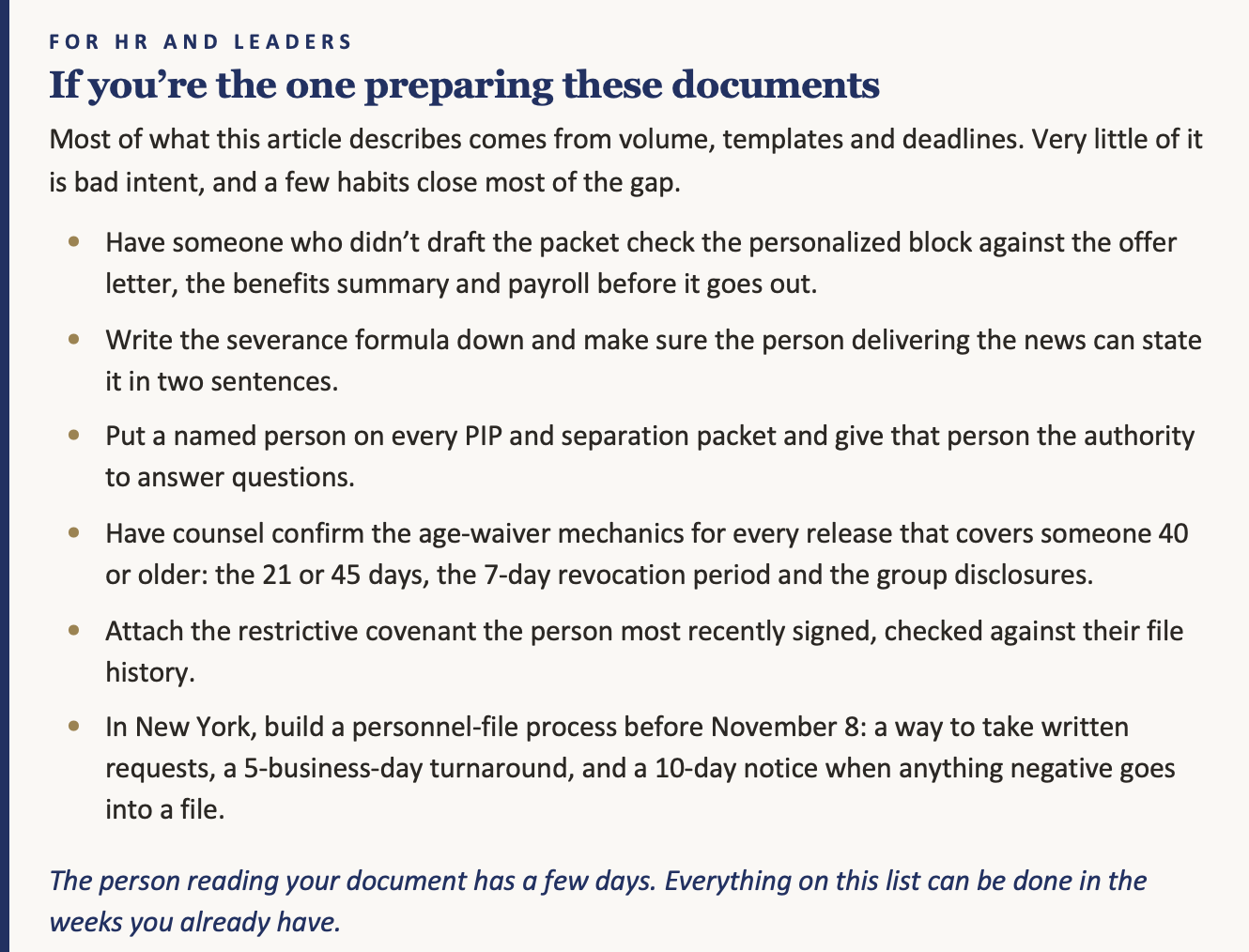
Preparing a performance improvement plan (PIP) or a severance agreement
The double standard in a performance plan
If what you’re holding is a performance plan, this part is for you. It’s also the stage where you still have the most room to move.
Companies are careful with the paperwork that protects them. Reviews, written warnings and performance plans all get dated and filed. What happens to you in between, like the offhand feedback or the project that quietly moved to someone else, rarely gets written down. By the time there's a dispute, the only version on paper is theirs.
The person below is a composite drawn from separate matters at separate employers. Every element happened; they just didn’t all happen to one person.
An employee is placed on a performance improvement plan alleging 12 months of deficiency. Several of the most serious findings rest on recollection, and the plan itself acknowledges that supporting records are missing. The specific deliverables are put in writing only days before the submission is judged incomplete. The employee improves anyway, and the evaluation says so, then discounts it on the stated basis that improvement occurring after feedback doesn’t count as improvement. Read that twice. It is the corrective purpose of a performance improvement plan, described and then disqualified. Meanwhile, the performance question at the center of it traces back to a process failure that was on record before the plan was written.
Nothing in that sequence required anyone to act in bad faith, and that’s exactly why it matters. The asymmetry is built into the process, and nothing in the process corrects it.
Keeping your own record might feel paranoid. It’s the most reliable counterweight you have.
New York is about to put part of this into law. Under a statute signed on September 9, starting November 8, 2026, employers must tell employees within 10 days when they add something negative to a personnel file, and the employee can respond in writing and have that response kept in the file. Current and former employees can also request a free copy of their file, which the employer must produce within 5 business days. [1] Lawmakers have agreed to clarify its scope in 2027, so check the current text before relying on the details. The written response I’d tell you to make anyway is becoming a legal right.
The formula nobody will show you
Severance is presented as a calculation. It is almost never explained as one, and most people don’t realize that asking how it was calculated is a fair question.
I’ve worked with people separated by the same employer, on the same day, in the same reduction, whose packages tracked neither tenure nor pay nor seniority in any way you could reconstruct from outside. In one case, someone with longer service received fewer weeks of severance than a colleague with shorter service. The longer-serving person’s agreement contained no stated multiplier, no published policy, and no description anywhere of how the total was reached.
You’re being asked to accept a number with no way to check whether it was applied to you the way it was applied to the person at the next desk.
So ask: “What’s the formula, and how was it applied to me?” It’s a routine administrative question, even if it feels confrontational to put in writing, and how it gets answered tells you a great deal. A company with a consistent formula can state it in two sentences. A company that can’t, or won’t, has told you something.
At larger employers the formula often lives in a written severance plan. If yours is paid under a formal plan governed by the federal benefits law known as ERISA, the plan administrator generally has to give you a copy of the plan documents when you ask in writing. [2] If you were ever handed a summary plan description for it, look for a section called “Statement of ERISA Rights.”
Age changes the document
If you’re 40 or older, make a note of this. Federal law gives you something most people don’t know they have, and it’s one of the few points in this process where an employer can be required to show its work.
Under the Older Workers Benefit Protection Act, and the regulations the U.S. Equal Employment Opportunity Commission (EEOC) uses to enforce it, a severance agreement that asks you to give up age discrimination claims has to meet specific requirements. Among other things, it has to name the Age Discrimination in Employment Act (ADEA) explicitly, advise you in writing to consult an attorney, and give you at least 21 days to decide, or 45 in a group layoff, plus 7 days after signing to change your mind.[3]
In a group layoff there’s more. The employer has to tell you in writing which group the selections were drawn from (the regulations call it the decisional unit), what the eligibility factors were, the job titles and ages of everyone eligible or selected, and the ages of everyone in the same job classification or unit who wasn’t. Actual ages, not age bands. Those disclosures are due when your 45 days begin.[4]
That disclosure is the answer to the formula question: a document that shows you the shape of the decision that removed you.
THE AGE-WAIVER RULES AT A GLANCE
Applies to employees 40 and older. Sources: 29 U.S.C. § 626(f); 29 C.F.R. § 1625.22.
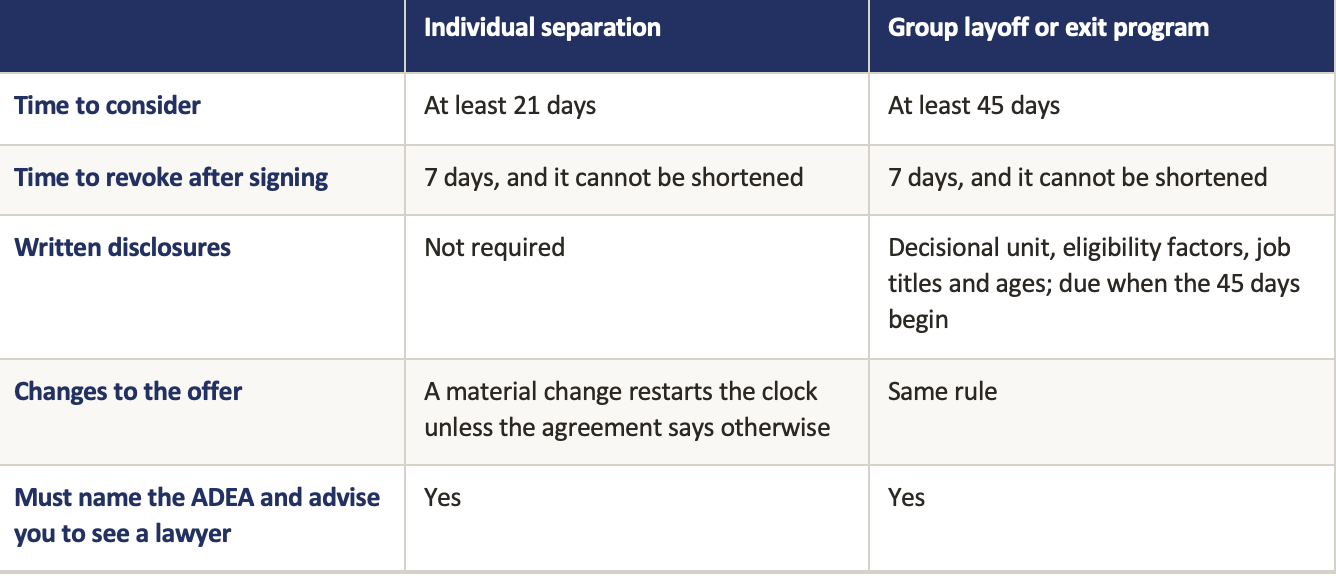
If an employer skips a required element, gives you 21 days where 45 were required, or never names the ADEA, the age waiver doesn’t meet the law’s “knowing and voluntary” standard, and it won’t block an age claim.[3] That result is narrower than it sounds, because the rest of the release can still hold. You also don’t have to hand the severance back before challenging an age waiver that falls short, although a court can later deduct it from anything you recover.[5]
The 15-second check, which almost nobody does, is to look for the ADEA by name in your release. If your agreement runs through a long list of statutes, names the Americans with Disabilities Act and never mentions the ADEA, don’t assume it’s a typo. If it also gives you only 14 days to consider it, has no revocation period and attaches no age disclosures, those facts fit together. They describe an agreement that may have been built to leave the age waiver out altogether, which would generally leave federal age claims outside what you’re giving up.
What you’re keeping by signing is a question for an employment attorney, and it’s worth the consultation. You can only ask it if you noticed.
Count the clocks
Something I missed until I’d read a lot of these is that negotiating doesn’t necessarily buy you time. Under the federal age-waiver rules, a material change to the offer restarts the consideration period by default, but the agreement can say that no change restarts it, and many do.[6 ]Outside those rules, the deadline is whatever the document says. Either way, the days you spend negotiating can come straight out of the days you have to decide, and the two deadlines can fall on the same date. Negotiating spends the clock it depends on.
You’re allowed to sign early. For age waivers, though, an employer can’t push you there by threatening to pull the offer or by giving better terms to people who sign fast.[6]
There are other clocks, and they rarely appear together on one page.
Vesting usually stops on your separation date, and anything scheduled to vest after it is gone. Equity vests in chunks, called tranches, on set dates, and I’ve watched meaningful amounts land days on the wrong side of that line. Pull your vesting schedule before you respond to anything, because a tranche just past the cutoff turns a general request into a specific one. “Please reconsider the package” is easy to decline. “My next tranche vests 11 days after your cutoff date” is a question somebody has to answer.
Vested stock options commonly have to be exercised within about 90 days of termination, and unvested ones end on the termination date unless your agreement says otherwise. That’s easy to lose track of after a long tenure, and expensive to miss.
Employer-paid health coverage frequently ends as soon as you become eligible for coverage through a new job, even if you haven’t enrolled. The word “eligible” can cost you months of premiums. Asking to change it to “enrolled,” or to convert the remaining months to cash, is a small request that gets granted more often than people expect.
Check which restrictions you signed
This one surprised me most: two people can leave the same company on the same day, in the same reduction, under completely different post-employment restrictions, purely because of when they signed. Older agreements tend to be much broader. At one employer, a version from the early 2010s ran a full year, worldwide, with no definition of the work it restricted. The version signed a few years later ran six months, narrowly drawn, with examples of what was still allowed.
People also get this wrong in the other direction. Someone with no post-employment non-compete assumes they have one, because competition language appears in their agreement in a clause that only applied while they were employed. That assumption costs people opportunities they never pursue.
There are two questions I want you to ask yourself. First, is this the current version of what I signed, or have I signed something newer since? Promotions, equity grants, policy refreshes and handbook acknowledgments can all carry covenants, and a newer one may replace the old. Employers attach whatever exhibit is on file, and files go stale. Second, what does mine prohibit, specifically? Whether it’s enforceable is a question for counsel, and state law on non-competes varies widely and keeps changing. What the document says is something you can check today.
What signing gives up
Most agreements preserve your right to file a charge with the EEOC and other agencies. Many people read that as keeping their claim. It usually means something narrower. The same section frequently waives your right to individual relief, meaning back pay, front pay or reinstatement, in any proceeding that follows. You keep the ability to report. You give up the ability to recover.
Then read the section usually titled “Representations” or “Acknowledgments” slowly, because statements of fact get buried in it. Look for what you’re being asked to assert as true: that every work-related injury was reported, that you received the leave you were entitled to and nobody treated you badly for taking it, that you have no complaint pending anywhere, including one you raised internally and never heard back about.
An acknowledgment says you read something. A representation says you’re vouching for a fact, and the company is relying on you for it. If one of those isn’t true in your situation, signing creates a new problem instead of closing an old one. That’s a conversation to have with an employment attorney before you sign.
Two numbers, doing two different jobs
Here’s the part I’ve changed my mind about. People are often told to negotiate from where they’d have been in a year rather than where they are today. I think that framing is right, and usually pointed at the wrong target.
Use a projection to decide. A solid projection lays out where you’d realistically have been in 6 to 12 months if none of this had happened: salary, bonus, the vest that was coming, the promotion that was close. Then set it against how long you might be looking. In August 2026, the median unemployed person in the U.S. had been out of work for 11.4 weeks, while the average stretched to 26.3 weeks, pulled up by the 27 percent who had been looking for six months or longer.[7]Both numbers are true at once, and the gap between them is the useful part. Plan your finances against the average and judge your search against the median. That arithmetic tells you what you need and whether this offer gets you there. It’s the most important calculation you will do, and it’s entirely for you.
Then negotiate from the document. What actually moves is specific and unglamorous: a vest date on the wrong side of a cutoff, a coverage clause that turns on eligibility instead of enrollment, a payout line that appears in every other version of the agreement and is missing from yours. Concrete questions about their own paperwork get answered. A 12-month career projection, however accurate, lands as a plea, because the company has no obligation to price your trajectory and knows it.
What I’d tell you to do this week
Before anything else, save what belongs to you. Your reviews, your offer letter, your pay history, the agreements you’ve signed over the years, your own notes. Access usually ends the same day the conversation happens, and once it’s gone, it’s gone. If you can see this coming, do it now, while it’s routine. Take what’s yours and nothing that isn’t. The line between protecting your own record and taking company material is one you can’t afford to cross by accident, so when you’re unsure, ask HR for copies in writing. In New York, from November 8, former employees can also request a copy of their personnel file.[1]
Then slow down and read the six lines that are about you. Check the math, check the dates, and check that what you were told matches what the paper says.
One more thing. What helped most in nearly every matter I’ve worked on this year was something small the person did at the time, on their own, before anyone advised them to. A dated note. A written objection logged the same day. An email that put a disagreement on the record while the facts were fresh. Small habits, every one of them.
Those habits are what The Quiet Baseline is built around. It’s the documentation framework I use with clients, and it comes down to a dated record of what happened, written the same day, before you need it. The packet is the company’s record. The notes you keep are yours.
The paperwork doesn’t know who you are. It was written for a category, assembled at speed, and sent to a list. Your job, in the narrow window you have, is to make it account for the specific person it landed on.
Nothing in this article asks you to take my word for it. Sources and references are here.
ABOUT THE AUTHOR
Aidan L. Takhteyev is the founder of Quiet Ally LLC, a New York-based, LGBTQ+-owned employee relations advisory firm. He has spent more than 15 years in HR and employee relations, much of it on the employer’s side of the conversations described here. Quiet Ally reads separation agreements, performance plans and severance packages with the people who receive them, before the deadline, and tells them plainly what the document says and what to ask. Aidan@QuietAllyHR.com · quietallyhr.com
Quiet Ally provides strategic HR guidance and does not offer legal advice.
